

A wrap around extension is one of the most transformative projects you can do to a UK home. It combines a rear extension with a side return extension to create one large, flowing space — and done well, it can completely change how you live in your house.
If you’ve got a terrace or semi-detached property with a narrow side passage running alongside it, you might be sitting on more potential than you realise. That side return — the bit that’s usually just a bin run or a forgotten strip of garden — can become part of something genuinely special.
Here’s everything you need to know about wrap around extensions: what they are, how much they cost, whether you’ll need planning permission, and how to get one designed and built.
What Is a Wrap Around Extension?
A wrap around extension (sometimes written as “wraparound extension”) extends your home outwards at the rear and across the side at the same time. The two parts of the extension meet at a corner, literally wrapping around two sides of the house.
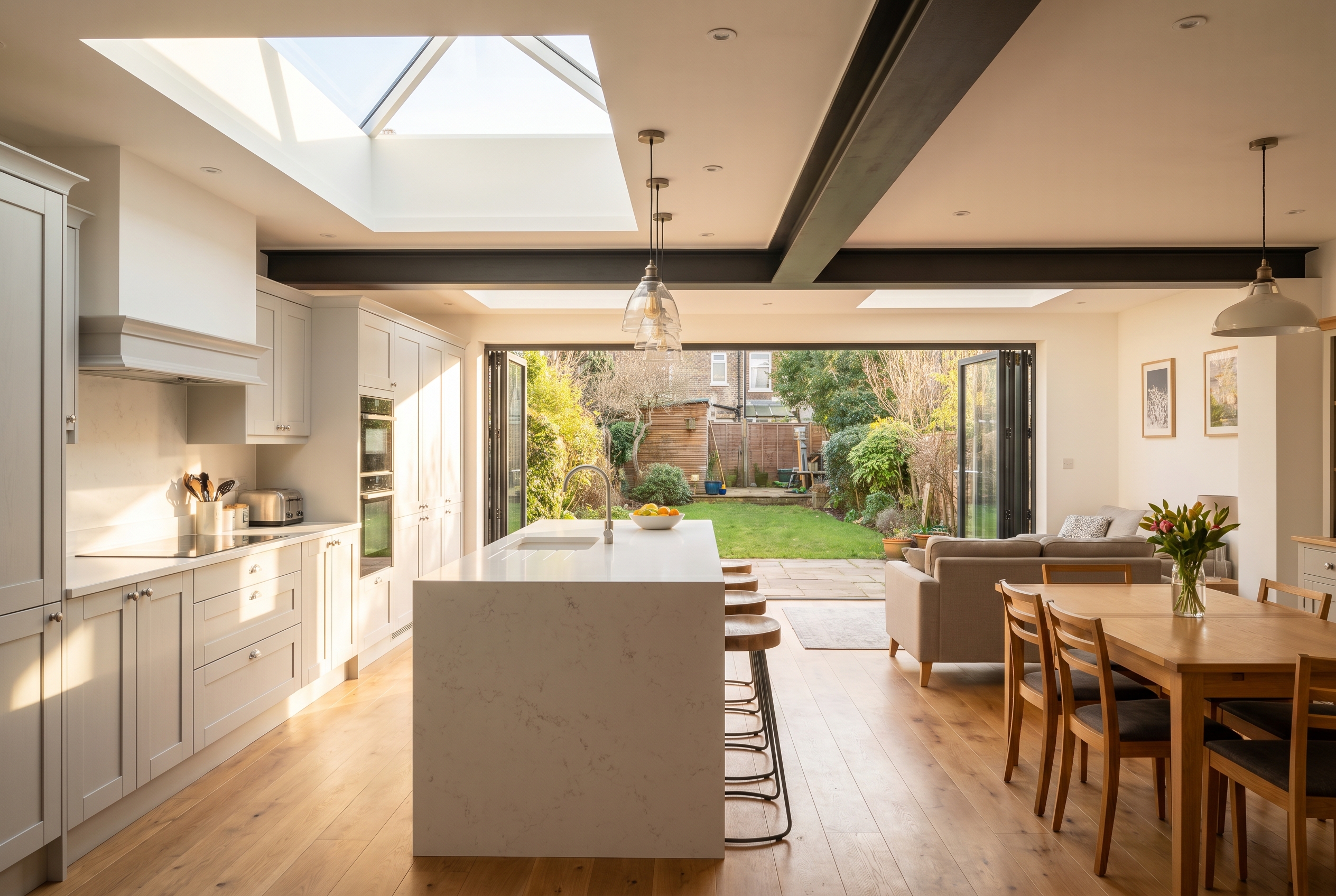
The result is typically an L-shaped or C-shaped footprint that dramatically increases the ground floor square footage. Most people use the space for an open-plan kitchen, dining room and living area — all under one roof, flooded with natural light.
They’re most common on Victorian and Edwardian terraces and semis, where the side return is a standard feature. But they can work on any property that has space down one side.
How Much Does a Wrap Around Extension Cost in the UK?
Because a wrap around extension is essentially two extensions joined together, it costs more than either element on its own — but usually less than building them separately.
As a rough guide for 2026:
- Small wrap around (up to 25m²): £55,000–£85,000
- Medium wrap around (25–40m²): £80,000–£130,000
- Large wrap around (40m²+): £120,000–£200,000+
These figures include build costs but not fixtures and fittings. If you’re planning a new kitchen as part of the project — which most people are — budget an extra £10,000–£30,000 depending on the spec.
London and the South East sit at the top end of those ranges. Wales, the North, and the Midlands are generally 15–25% cheaper for the same build.
On top of build costs, you’ll need to factor in:
- Design and planning drawings: from around £1,500–£3,000 depending on the provider
- Planning application fee: £528 for a householder application in England (2026)
- Building regulations: typically £800–£1,500 depending on your local authority
- Party wall surveyor: £700–£1,500 if your neighbours are involved (likely for a side return)
Do You Need Planning Permission for a Wrap Around Extension?
This is where it gets a bit nuanced — and it’s the question we get asked most often.
The rear element of a wrap around extension often qualifies as permitted development (PD) — meaning no planning application needed. But the side element usually requires planning permission, because permitted development rights for side extensions are more restrictive.
Under current PD rules in England:
- Side extensions must be single storey, no taller than 4m, and no wider than half the width of the original house
- They can’t extend beyond the principal (front) elevation
- Properties in designated areas (conservation areas, Areas of Outstanding Natural Beauty, listed buildings) have more restrictions
Because the side element and the rear element are physically connected in a wrap around, most councils treat the whole thing as a single project and require a planning application for it all. In practice, planning permission is almost always required for a wrap around extension.
The good news: most wrap around extensions on standard residential properties get approved without issue, especially if the design is well-considered. Approval rates for householder extensions across England and Wales run at around 85–90%.
If you want to understand your specific situation before spending anything, we can help — take a look at our house extension drawings and planning service.
Design Ideas for Wrap Around Extensions
The beauty of a wrap around is the amount of design freedom you get. Here are some of the most popular approaches:
Open-Plan Kitchen Diner
The classic. The side return becomes a breakfast area or dining zone, while the rear extension houses a larger kitchen. A roof lantern or glazed ceiling over the side return brings in light that was previously blocked by the party wall. Bi-fold or sliding doors to the garden make the whole thing feel twice as big on a sunny day.
Kitchen Plus Separate Utility
If you want a proper utility room (and who doesn’t), the side return is the perfect location. It keeps the kitchen clean and gives you somewhere to dump muddy boots, school bags, and the dog without it all ending up in your living space.
Full Ground Floor Reconfiguration
Some homeowners use the added square footage as an opportunity to rethink the entire ground floor — moving the kitchen from the front of the house to the rear, creating a proper hallway, and opening everything up. This is more involved but can turn a cramped Victorian terrace into something that feels genuinely modern.
Glazed Roof Details
Roof lanterns, skylights, and glazed flat roofs are all popular in wrap around extensions. They solve the light problem that comes with building close to a boundary and can be genuinely stunning when done well.
Structural Considerations
A wrap around extension involves removing external walls to create the open-plan space — which means steelwork. You’ll typically need one or two RSJ (rolled steel joist) beams spanning across the opening, supported by padstones and new foundations.
This is completely routine for a competent structural engineer and builder. It’s factored into any proper build cost. But it’s worth knowing, because it means the structural calculations are a non-negotiable part of the project — your building control submission won’t be approved without them.
At Arkiplan, structural calculations are included in our service — your designer handles everything in-house, so you’re not left chasing separate engineers.
Party Wall Considerations
If your side return runs along a shared boundary with a neighbour, you’ll almost certainly need to comply with the Party Wall etc. Act 1996. This applies when you’re building within 3 metres of a neighbour’s foundations or cutting into a shared (party) wall.
In practice, for a wrap around on a terrace or semi, you’ll serve a party wall notice on the affected neighbour(s). If they agree in writing, you can proceed. If they dissent (or don’t respond within 14 days), you’ll need a party wall surveyor to agree an Award — essentially a formal document protecting both sides.
It sounds bureaucratic, but it’s fairly straightforward in most cases. Most neighbours agree once they understand what’s happening. Budget around £700–£1,500 for a surveyor if you need one.
How Long Does a Wrap Around Extension Take?
From getting your drawings done to moving back into your new kitchen, here’s a realistic timeline:
- Design and planning drawings: 3–6 weeks
- Planning decision: 8–10 weeks (council target from valid application)
- Building regulations approval: 5–8 weeks if submitted alongside planning
- Finding a builder and getting quotes: 4–8 weeks
- Build: 12–20 weeks depending on size and complexity
Total from kick-off to completion: roughly 9–15 months for most projects. That sounds like a long time, but a lot of it runs in parallel — you don’t just sit around waiting for planning to be approved before you start talking to builders.
Is a Wrap Around Extension Worth It?
For the right property and the right family, absolutely. A well-designed wrap around extension typically adds more in value than it costs — particularly in higher-value areas. More importantly, it changes how you actually live in your home.
The families who get the most out of them are usually those who’ve outgrown their current kitchen/dining setup, want a better connection to the garden, or are trying to avoid the upheaval and cost of moving. If any of that sounds like you, it’s probably worth exploring.
If you’re not sure whether your property has the space or the planning potential, that’s exactly what the design process is for. A good designer will tell you what’s realistic before you commit to anything.
We do this every day — take a look at how our house extension drawings service works, or if you’re also thinking about upstairs space, our loft conversion drawings service might be relevant too.
Ready to Get Started?
You don’t need to have all the answers before you reach out. Most people come to us with a rough idea and a budget — we help figure out the rest. Fixed price from the start, everything handled in-house, and a planning permission guarantee.