

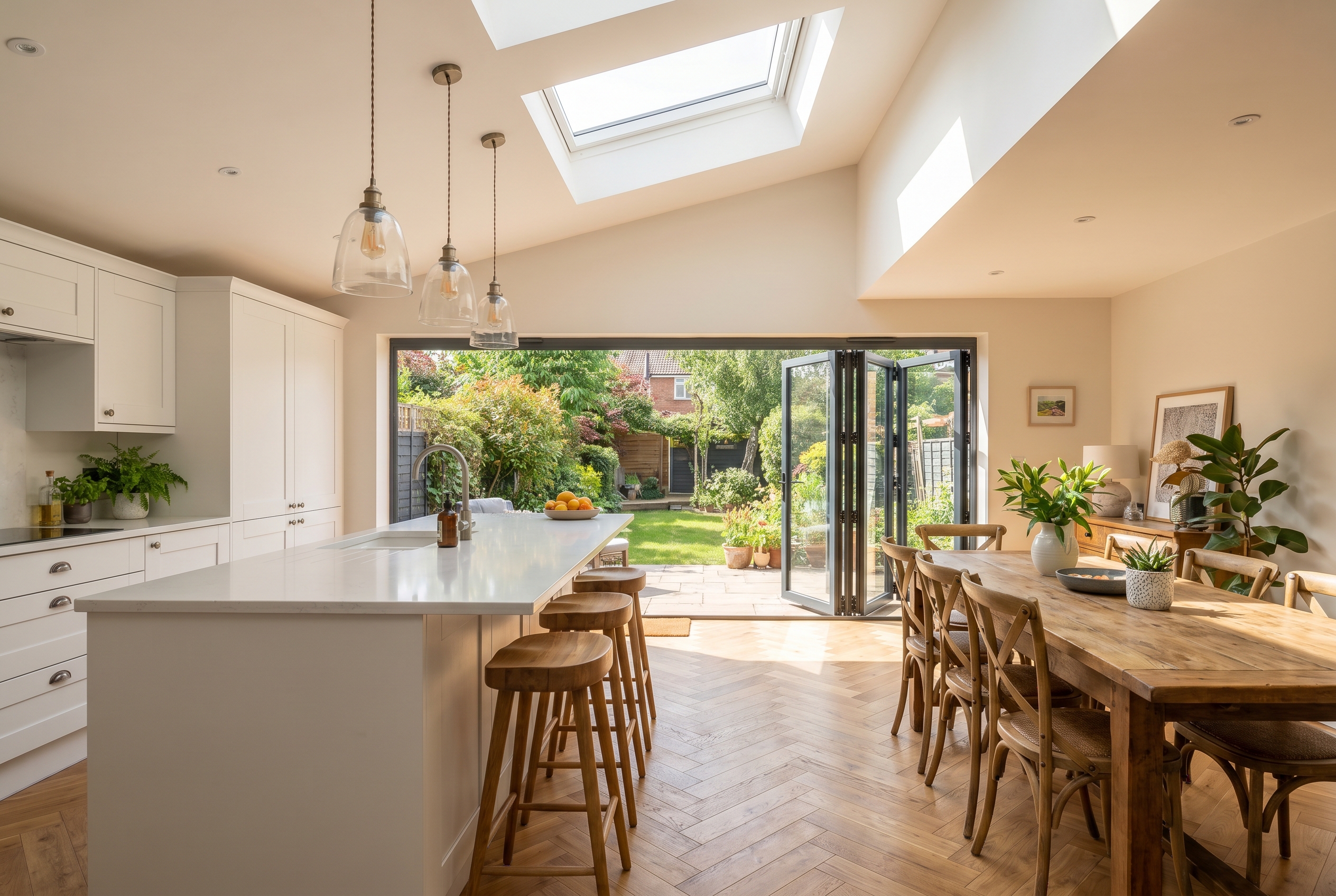
A wrap around extension is one of the most transformative things you can do to a semi-detached or end-of-terrace home. It combines a rear extension with a side return extension — filling in that narrow gap down the side of your house and wrapping around the back — to create a genuinely large, open-plan ground floor space.
Done well, it turns a cramped Victorian terrace into something that feels twice the size. The kitchen opens up, the garden connection improves, and suddenly you’ve got the kind of home you’d have to move to get otherwise.
So: what does a wrap around extension cost in 2026? Do you need planning permission? And is it worth it? Here’s everything you need to know.
What Is a Wrap Around Extension?
A wrap around extension is an L-shaped single storey addition that extends both to the rear and along the side of a property. It’s typically built on semi-detached houses, end-of-terrace houses, and occasionally detached homes where there’s a narrow side passage worth reclaiming.
The “wrap” refers to the way the extension turns the corner — rather than building straight back, the new floor space wraps around the side of the house and connects into one continuous open layout.
Most commonly, this creates an extended kitchen-diner-living area at the back, with the side return adding width that otherwise wouldn’t exist. It’s a particularly popular choice for Victorian and Edwardian semis, which tend to have that characteristic narrow side gap of around 1–2 metres.
How Much Does a Wrap Around Extension Cost?
A wrap around extension will typically cost between £60,000 and £120,000 in the UK in 2026, depending on size, spec, and location. Here’s a rough breakdown:
- Smaller wrap around (15–20m²): £55,000–£75,000
- Mid-size (20–30m²): £75,000–£95,000
- Larger or high-spec (30m²+): £95,000–£120,000+
London and the South East typically add 15–25% to these figures. A wrap around in Cardiff or Manchester will generally come in cheaper than the same project in Surrey or Bristol.
The main cost drivers are:
- Size — more floor space means more materials, more groundwork, longer build
- Glazing — bifold or sliding doors and rooflights cost significantly more than standard windows
- Structural complexity — knocking through to the existing house, removing chimneys or load-bearing walls adds cost
- Roof type — a flat roof with a rooflight is usually cheaper than a pitched or lantern roof
- Fit-out — a new kitchen on top of the build cost adds another £10,000–£40,000 depending on spec
Do You Need Planning Permission for a Wrap Around Extension?
This is where wrap arounds get a bit more complicated than a simple rear extension — and it’s important to get right before you start.
The Rear Part
The rear element of a wrap around extension will usually fall under permitted development — meaning you don’t need full planning permission. Under current rules, you can extend up to 3 metres beyond the original rear wall on a semi-detached house (or 4 metres on a detached) without planning, subject to height and other restrictions.
If you want to go beyond those limits, the Larger Home Extension scheme (prior approval) allows extensions of up to 6 metres on a semi-detached under certain conditions — you need to notify the council, who then consult your neighbours.
The Side Return Part
The side element is trickier. Side extensions under permitted development are limited to a width no greater than half the width of the original house — so if your house is 5 metres wide, your side extension can be no more than 2.5 metres wide.
Critically, if your property is on a designated road (the side wall faces a highway), the side extension does require planning permission regardless of size. This catches a lot of people out — particularly corner plots and houses where the side of the property is visible from the street.
In many cases, wrap around extensions do need planning permission, either because of the side return rules or because the combined footprint exceeds permitted development limits. This isn’t necessarily a problem — most applications for well-designed wrap arounds are approved — but you need to factor in the time and cost for a planning application.
For a detailed breakdown of what does and doesn’t need planning, see our guide to house extension drawings and planning.
Building Regulations — What You’ll Need
Regardless of whether planning permission is required, all wrap around extensions need to comply with building regulations. This is separate from planning — it’s about structural safety, insulation, drainage, and fire safety.
Key areas covered include:
- Foundations and structure — load calculations, beam and lintel specs for any openings into the existing house
- Thermal performance — walls, roof, and floor must meet current U-value requirements
- Drainage — foul and surface water must be properly managed, especially if the extension covers existing drainage runs
- Ventilation — particularly important for open-plan kitchen-diners
- Electrical and gas connections — any new consumer units, gas connections, or boiler relocations need sign-off
Building regs approval is obtained either via a full plans application (drawings submitted in advance, checked by the council or an approved inspector) or a building notice (no drawings submitted, inspector visits during the build). For a project the size of a wrap around extension, full plans is almost always the better route — it gives your builder certainty and protects you if anything’s questioned later.
How Long Does a Wrap Around Extension Take?
From first conversation to moving back in, expect the process to take around 9–14 months in total, broken down roughly as:
- Design and drawings: 3–6 weeks (with Arkiplan, usually at the faster end)
- Planning application (if needed): 8–10 weeks for a decision
- Building regs approval: Can run alongside planning or afterwards; full plans takes 5–8 weeks
- Finding a builder and getting quotes: 2–4 weeks
- Build: 12–20 weeks depending on size and complexity
Most builders won’t start on site until planning is approved and building regs are in place, so the pre-construction phase matters more than people realise. Get your drawings sorted early and you’ll shave weeks off the overall timeline.
Design Tips for Wrap Around Extensions
1. Think About the Connection First
The existing house and the new extension need to feel like one space. This usually means removing the original rear wall or most of it, and using steels to span the opening. The wider you can make that connection, the more open the final result.
2. Rooflights Over the Side Return
The side return portion of a wrap around tends to sit deep into the plot — away from the rear wall of the existing house. Without rooflights, this area can feel dark. A full-length rooflight (or a series of them) brings in light from above and transforms the feel of the space. Budget around £2,000–£5,000 per rooflight fitted.
3. Bifold or Slide-and-Turn Doors
The rear-facing wall of the extension is your opportunity for a large glazed opening onto the garden. Bifold doors are the most popular choice — they stack neatly to the side and create a wide, seamless opening. Slide-and-turn (also called sliding or “slim frame”) doors are slightly more expensive but often cleaner in appearance. Either way, this is not somewhere to cut corners — it’s the focal point of the whole project.
4. Flat Roof vs Pitched Roof
Most single storey wrap arounds use a flat roof — it’s cheaper, allows for rooflights, and keeps the overall height down (which matters for planning). A pitched roof can look more traditional and may be required in conservation areas or where the council has design guidance, but it adds cost and limits your rooflight options.
Is a Wrap Around Extension Worth It?
Almost always, yes — but the maths depends on your property and location.
A well-executed wrap around extension on a three-bedroom semi in Cardiff, Manchester, or Birmingham typically adds £80,000–£130,000 to the value of the property. On a similar property in London or the Home Counties, that uplift can be £150,000+.
If you’re spending £80,000 to add £100,000 in value — plus getting a far better home to live in during that time — the numbers usually stack up. The key is getting the design right from the start so you’re not paying for revisions or resubmissions.
Getting proper drawings done is the single most important step. Rushing into planning with sketchy drawings is one of the most common reasons projects get delayed or refused. See what’s included in our house extension drawings service and how we handle the full application process end to end.
How Arkiplan Can Help
We handle everything from the initial design through to planning permission and building regulations approval — all at a fixed price, with no surprises. Most projects are turned around in 3–6 weeks from survey to submission, compared to the 3–6 months you’d typically wait with other companies.
We use LiDAR 3D scanning to survey your home — no tapes, no second visits, no measuring errors. Our designers work through video meetings, so you get expert input without the traditional waiting around.
And we’re upfront about pricing from day one. You’ll know exactly what you’re paying before we start — no hourly rates, no escalating invoices.
If you’re thinking about a wrap around extension, the first step is getting a quote.