

When you’re planning a house extension, most of the early focus tends to go on planning permission — and for good reason. But once planning is approved (or if it falls under permitted development), there’s another hurdle that’s just as important: building regulations.
Building regulations are the legal standards your extension must meet for structural integrity, fire safety, energy efficiency, and more. Unlike planning permission, which is about whether you can build something, building regs are about how it gets built. Almost every extension requires building regulations approval — no matter how small.
This guide breaks down everything you need to know: what building regulations actually cover, how the approval process works, and what happens if things go wrong.
What Are Building Regulations?
Building regulations are a set of minimum standards set by the UK government that apply to most types of construction and alteration work. They’re enforced by your local council’s building control department — or by an approved inspector from a private firm.
The regulations cover everything from the foundations and structural steelwork through to insulation, ventilation, electrics, drainage, and fire escape routes. They exist to make sure buildings are safe to live in and won’t cause problems for future owners.
It’s worth knowing that building regulations approval is completely separate from planning permission. You can have planning permission but still need to get building regs signed off — and vice versa. Some very minor works are exempt from both; others only need one or the other. But for a typical house extension, you’ll need both.
Which Extensions Need Building Regulations Approval?
Almost all extensions require building regulations, including:
- Single and double storey rear extensions
- Side extensions
- Wrap-around extensions
- Garage conversions
- Loft conversions
- Basement conversions
- Porch additions (if over 30m² or if the internal door is removed)
Some minor works are exempt — such as a small conservatory under 30m² with a thermal separation from the main house, or a detached outbuilding under certain size thresholds. But the vast majority of home extension projects will require sign-off.
If you’re unsure, it’s always better to check with your local council or speak to an architectural designer before starting work. At Arkiplan, we handle all building regulations submissions as part of our service — so you never have to figure this out alone. See what’s included in our extension drawings package.
What Do Building Regulations Actually Cover?
The regulations are split into sections (called “Approved Documents”), each covering a different aspect of construction. Here’s a plain-English breakdown of the main ones relevant to house extensions:
Structure (Part A)
Your extension must be structurally sound. This covers foundations, walls, floors, and roofs. For most extensions, a structural engineer will be needed to design the steel beams and specify the foundation depth — particularly if you’re removing a load-bearing wall or building close to a boundary.
Fire Safety (Part B)
Building regs require safe means of escape in case of fire. If your extension adds a habitable room (like a bedroom or office), you may need mains-wired smoke alarms, heat detectors, or fire doors depending on where the room sits within the house. An escape window may also be required.
Moisture Resistance (Part C)
Damp-proof courses, cavity walls, and proper waterproofing must be incorporated to prevent rising or penetrating damp. This is particularly relevant when tying a new extension into an older property.
Thermal Insulation (Part L)
Since 2022, the energy efficiency requirements for extensions have tightened significantly. New walls, floors, and roofs must meet minimum U-value standards (a measure of heat loss). This is one of the areas that catches people out — especially if they’re using a builder who isn’t up to date with current standards.
Drainage (Part H)
Any new drainage connections — for a kitchen, utility room, or WC — must comply with building regs. This includes ensuring the right falls on pipework and proper connections to existing drains.
Ventilation (Part F)
Extensions must have adequate ventilation to prevent condensation and maintain air quality. This is usually achieved through trickle vents in windows and extract fans in kitchens and bathrooms.
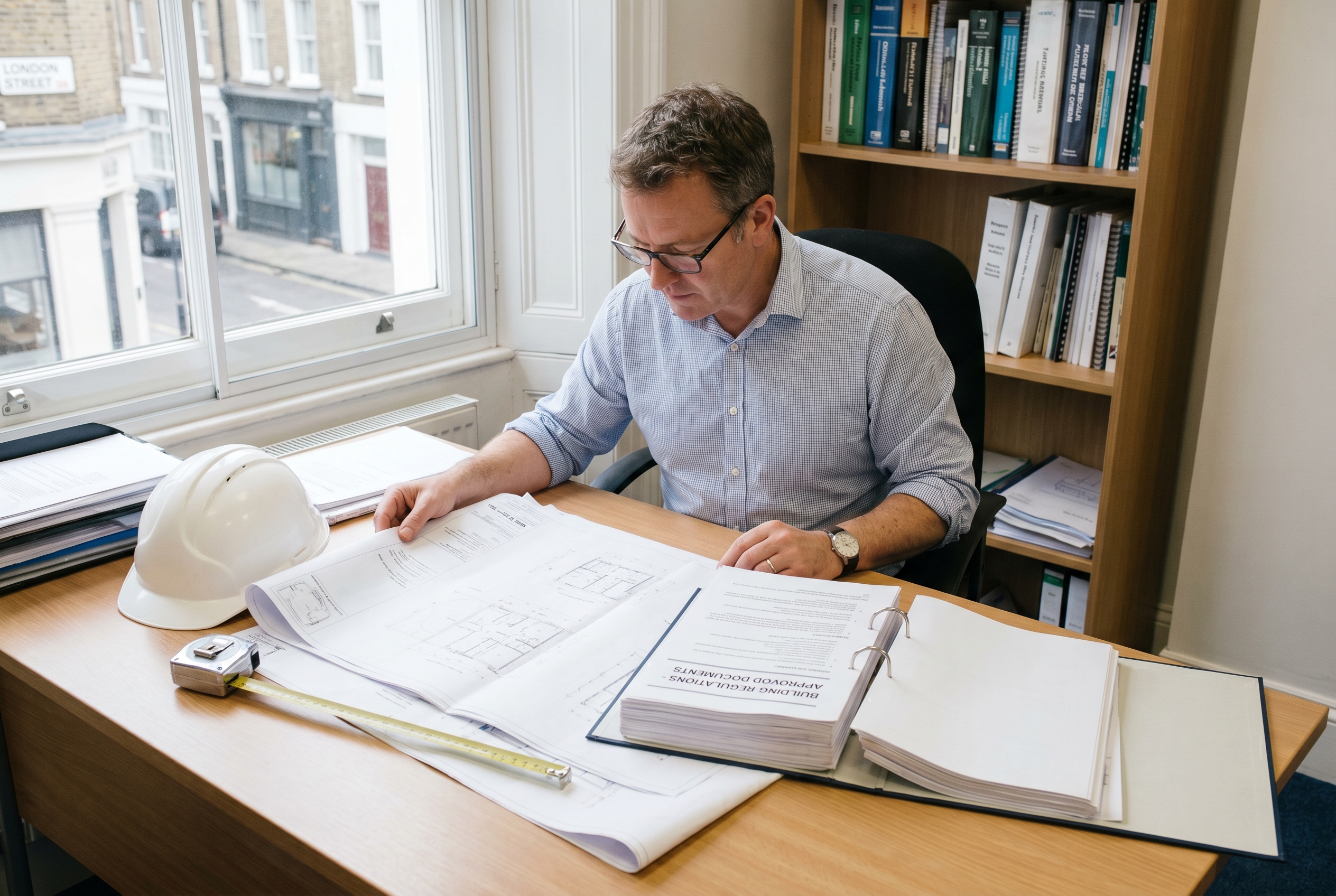
How Does the Building Regulations Approval Process Work?
There are two main routes to getting building regs approval for an extension:
1. Full Plans Application
This is the most thorough — and most recommended — route. Your architectural designer submits full technical drawings and specifications to building control before work starts. The inspector checks the plans, raises any queries, and issues approval. On-site inspections then happen at key stages during the build (foundations, damp proof course, roof, completion).
The advantage of full plans is that you get sign-off in writing before breaking ground. There are no nasty surprises mid-build, and your builder knows exactly what they need to achieve at each stage.
2. Building Notice
A building notice is a simpler notification — you tell the council you’re about to start work, and an inspector turns up at various stages to check compliance. No plans are submitted in advance.
This route is quicker to set up, but riskier. If the inspector flags an issue mid-build — say, the foundations aren’t deep enough or the insulation doesn’t meet spec — work may need to be undone and redone at your cost. It’s generally only recommended for straightforward, small-scale works by experienced builders.
At Arkiplan, we always submit full plans — it protects you, your builder, and ensures the process runs smoothly from start to finish. Find out more about our full plans service.
What Happens During On-Site Inspections?
Once work begins, your builder is responsible for notifying building control at specific stages so an inspector can visit. These typically include:
- Commencement — before any work begins
- Excavation — once foundations are dug but before concrete is poured
- Foundation concrete — once concrete is poured
- Oversite — before floor insulation and slab are laid
- Damp proof course — before external brickwork rises too high
- Roof structure — before roofing felt and tiles go on
- Drains — before backfilling
- Completion — final inspection once the works are finished
Missing an inspection can cause problems down the line — particularly at the completion stage, where inspectors may request opening up work to check what’s behind the walls. Don’t skip them.
What Is a Completion Certificate?
Once building control is satisfied that everything complies, they issue a completion certificate. This is your formal proof that the work was carried out to the required standard.
Keep it safe. You’ll need it when you come to sell the house — solicitors and buyers’ surveyors will ask for it. If you can’t produce one, you may be required to take out indemnity insurance, which adds cost and complication to a sale.
If you used an approved inspector (private) rather than the local council, they’ll issue a final certificate instead — which carries the same weight.
What About Retrospective Building Regulations?
Sometimes work is done without building regs sign-off — either because the homeowner didn’t realise it was needed, or a cowboy builder didn’t bother. If you’re buying a house with an extension that has no building regs certificate, a few things might happen:
- The seller may take out indemnity insurance to cover you as the buyer
- You can apply for a regularisation certificate from the local council — but this may involve opening up parts of the building for inspection
- If the work was done more than 12 months ago, the council can no longer take enforcement action — though this doesn’t mean the work is safe or that you’ll get a certificate
It’s a messy situation that’s easily avoided by doing things properly in the first place.
How Much Does a Building Regulations Application Cost?
Fees vary by local authority and the size of the project, but as a rough guide for a typical single-storey rear extension in England:
- Full plans application: £300–£700 (includes plan check and site inspections)
- Building notice: Similar fee, but no plan check element
In Wales, fees are set by each local authority and may differ slightly. Some private approved inspectors charge more, but can sometimes offer faster turnaround.
At Arkiplan, building regulations drawings and submission are included in our package — so there are no hidden extras. You pay one fixed price from the start. See our extension package.
Common Reasons Building Regs Get Rejected (and How to Avoid Them)
Most building regs rejections come down to a handful of issues:
- Insufficient structural information — no engineer’s calculations, or details that don’t add up
- Inadequate insulation specification — walls, floors, or roofs that won’t meet Part L
- Missing ventilation details — particularly for kitchens and bathrooms
- Fire safety gaps — no smoke detector plan, or inadequate escape provision
- Drainage details missing — especially on extensions with new plumbing
A good architectural designer will anticipate and address all of these before submission, minimising back-and-forth with building control.
Summary: What You Need to Remember
- Almost all extensions require building regulations approval — separate from planning permission
- Full plans is the safest route — issues are caught before work starts
- Your builder must arrange site inspections at key stages
- Always get your completion certificate — keep it safe for when you sell
- Work done without building regs can cause major problems down the line
Building regulations can feel like another layer of bureaucracy on top of an already complex process. But they exist to protect you — and getting them right from the start means your extension is safe, energy-efficient, and legally compliant for years to come.