

If you’re thinking about extending your home, one of the first decisions you’ll face is whether to go single storey or double storey. It’s not just about budget — it affects planning permission, disruption, build time, and how much your home actually grows in value. Here’s a straight-talking guide to help you choose.
What’s the difference between a single storey and double storey extension?
A single storey extension adds a new room (or rooms) at ground floor level only. Think of it as extending your footprint — a bigger kitchen, an open-plan living area, a playroom. It sits flat against your house and typically doesn’t require as much structural work as going up a level.
A double storey extension adds ground floor space and first floor space at the same time. You’re extending both the footprint and the height of the building. Done well, it’s one of the most cost-effective ways to significantly increase your home’s floor area.
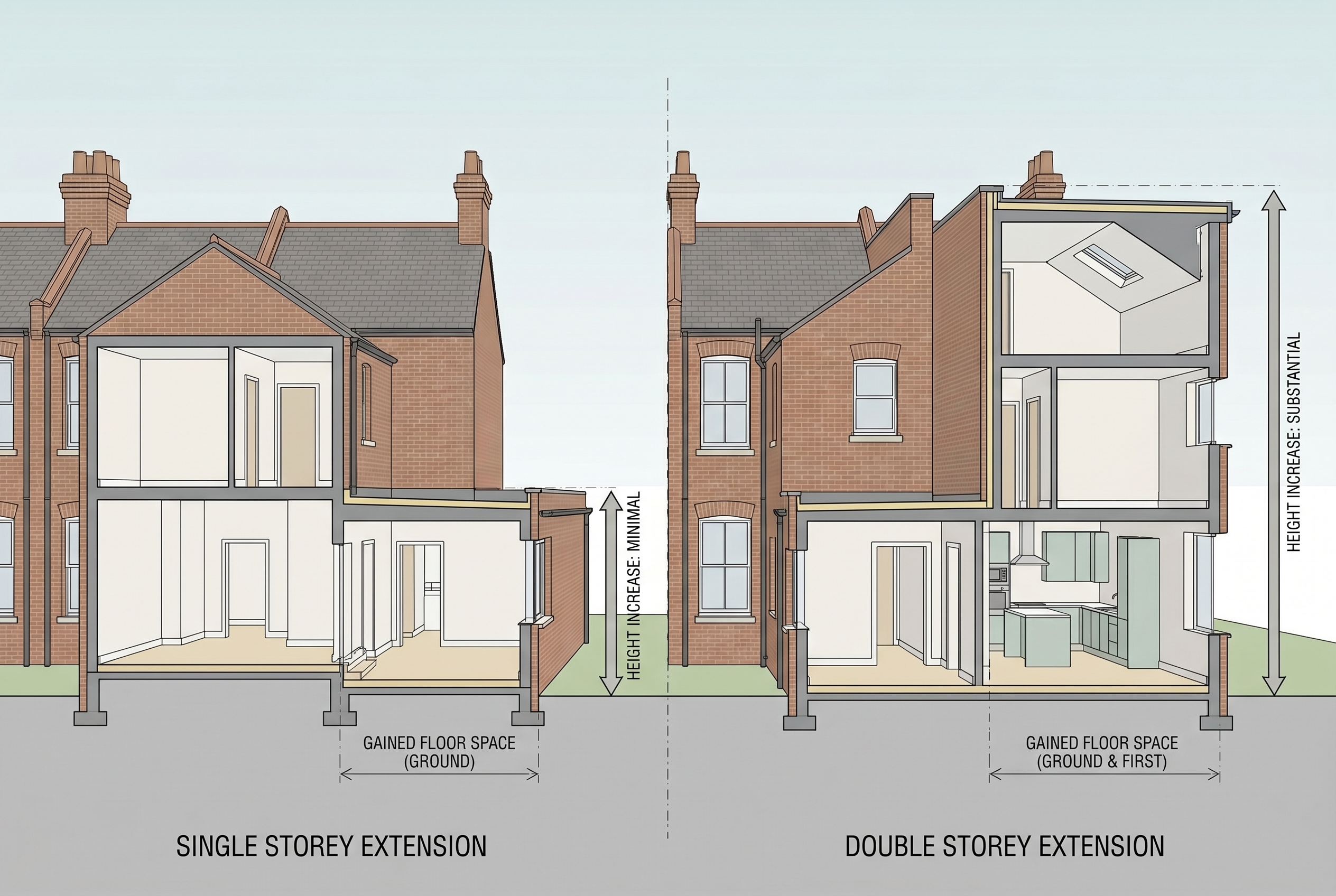
Single storey vs double storey extension: planning permission
This is where things get interesting. Many single storey rear extensions can be built under permitted development rights — meaning you don’t need full planning permission, just a building regulations sign-off. For a detached house, you can often extend up to 8 metres to the rear without planning; for a semi or terrace, it’s usually 6 metres (and up to 3m under standard permitted development, or up to 6m with the prior approval/larger home extension scheme).
Double storey extensions almost always require full planning permission. They’re bigger, they affect your neighbours’ light and outlook more significantly, and councils scrutinise them more carefully. That said, planning permission is very achievable with the right drawings and a well-considered design — Arkiplan handles thousands of these applications across England and Wales every year.
Need help working out what needs planning? Arkiplan’s house extension drawings service covers the full process — from design through to planning submission and building regulations.
Cost comparison: how much more does a double storey extension cost?
This surprises a lot of people: a double storey extension doesn’t cost twice as much as a single storey one. The foundations, roof, and scaffolding costs are shared across both levels, so you get significantly more space for a relatively modest extra spend.
Typical build costs (2026, UK)
- Single storey extension: £1,800–£2,500 per m² (so a 25m² extension might cost £45,000–£62,500)
- Double storey extension: £1,500–£2,200 per m² of total floor area (so the same 25m² per floor = 50m² total might cost £75,000–£110,000)
In that example, you’re doubling your new floor space for roughly 60–75% more money. That’s genuinely good value — which is why double storey extensions are popular in areas where house prices are high and moving costs are substantial.
These are build costs only. You’ll also need to factor in architect/drawing fees, planning application fees (£258 for most householder applications in England as of 2026), building regulations fees, and party wall surveys if applicable.
Which adds more value to your home?
Both add value, but double storey extensions generally come out on top — simply because they add more usable space. An extra bedroom (from the first floor addition) is one of the highest-value improvements you can make to a family home. Estate agents consistently report that adding a bedroom can add 10–15% to a property’s value, sometimes more in competitive markets.
Single storey extensions that create a better-flowing ground floor — open-plan kitchen-diners being the most popular — also add significant value and saleability, especially for family buyers. The return on investment is strong, but double storey tends to win on raw numbers if you’re extending specifically to build equity.
Build time: what to expect
Single storey extension timeline
- Drawings and planning: 8–12 weeks (longer if full planning required)
- Build: 12–20 weeks depending on size and spec
- Total from start to move-in: 5–8 months
Double storey extension timeline
- Drawings and planning: 10–16 weeks (planning required in most cases)
- Build: 20–30 weeks
- Total from start to move-in: 8–12 months
The double storey build takes longer because there’s more structural work involved — steel beams, first floor joists, staircase access if needed, and more complex roofing. But the payoff in extra space is worth the wait for most homeowners.
Impact on neighbours and the planning process
Single storey extensions are generally easier to get approved because their impact on neighbouring properties is more limited. They don’t usually overshadow next-door’s first floor windows, and they don’t overlook gardens from a height.
Double storey extensions need more careful design to pass planning. The key things councils look at:
- Overlooking — first floor windows shouldn’t look directly into neighbouring gardens or rooms
- Overshadowing — the extension shouldn’t block light to neighbouring windows
- Overbearing — the scale and bulk should feel proportionate to both your home and your street
- Design consistency — materials and style should complement the original building
A well-designed double storey extension sails through planning. A poorly thought-out one gets refused. This is exactly where having the right drawings and a clear design rationale makes all the difference.
Which should you choose? A simple guide
Choose a single storey extension if:
- You mainly want more ground floor living space (kitchen, dining, lounge)
- Your budget is under £60,000
- You want to avoid the planning permission process where possible
- You already have enough bedrooms and just want better everyday flow
- You’re on a terrace or semi and have limited rear garden depth
Choose a double storey extension if:
- You need an extra bedroom (or two) as well as more ground floor space
- You want to maximise value added per pound spent
- You’re planning to stay long-term and want a proper forever home
- You have the budget (typically £80,000+) and the timeline
- Moving to a bigger house would cost more than extending
What about a side extension?
Worth a quick mention: a side extension fills in the gap down the side of your property, and can be single or double storey. On a semi-detached, a double storey side extension is often restricted to a single storey under permitted development (to avoid making it look like a terraced property). These rules vary, so always check before designing.
A wraparound extension combines side and rear additions at ground floor level and can dramatically transform a home’s layout — worth considering if you want maximum ground floor space without going up a level.
Getting your drawings done right
Whichever route you choose, professional architectural drawings are the starting point. You need them for planning, for building regulations, and to give your builder accurate information to price and build from.
At Arkiplan, we handle the whole process — from an initial 3D scan of your home through to planning submission and building regulations sign-off. Fixed price from the start, with a planning permission guarantee. Our house extension drawings service covers both single and double storey extensions, and we’ve completed thousands of projects across England and Wales.
Not sure which option makes sense for your home? That’s exactly what our free design meeting is for.