Building regs guide · England & Wales

Building regulations drawings for extensions, lofts and conversions.

Planning and building regulations are two separate approvals. Planning decides whether you can build and how it looks. Building regulations govern how it is built — the structure, insulation, drainage, ventilation and fire safety.

Building regulations drawings show how your project will actually be built: the construction detail your builder works to and building control signs off.

Fixed priceDrawings & calcs agreed up front
England & WalesDrawn to the right national standard
We handle building controlSubmitted, inspected, signed off
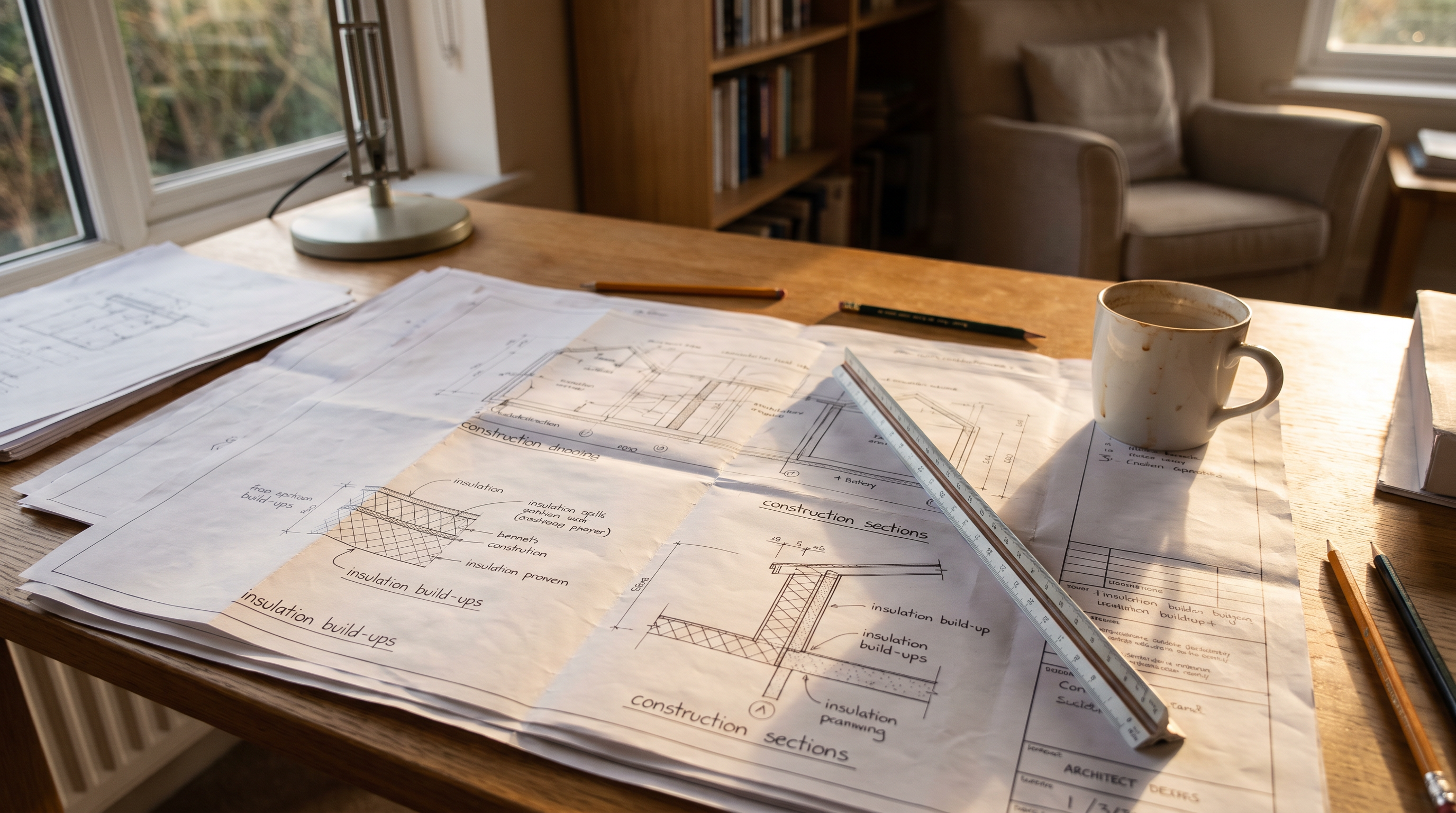
Building regulations drawing package for a house extension, with construction sections through the walls and roof, insulation build-ups and structural details annotated.

What building regulations drawings are — and when you need them

You need a building regulations package for nearly all structural work — a rear, side or two-storey extension, a loft or garage conversion, a new opening, or any work that removes or alters a load-bearing wall. That applies even when the work is permitted development and needs no planning permission at all. Loft conversions are a common example: many are permitted development, and they still need building regulations approval. There is more detail in our guide to building regulations for extensions.

It matters after the build, too. Without building control approval you will not have the certificates of compliance you may need when you come to sell your home.

What’s in a building regulations package

A planning drawing can be a line on a page. A building regulations drawing has to say what every line is made of. A package for a typical extension or loft covers:

You can see a real set here: example building regulations drawings (PDF).

Page from a finished building regulations package, showing a construction section cut through the wall, floor and roof with the insulation specification and beam positions marked.

Already have planning drawings? Here’s what changes

This is the most common starting point, and it catches people out. Planning drawings are not a head start on building control — they show shape, size and position, not construction. The building regulations set is drawn again from the inside out: build-ups, structure, drainage, ventilation and fire, all answering the Approved Documents.

If your planning drawings were prepared by someone else, bring them to the free design meeting. We will tell you straight what carries over, what has to be drawn from scratch, and whether anything in the approved design will be awkward to build as drawn.

Which Approved Documents your drawings have to answer

The Approved Documents are the official guidance to each part of the Building Regulations, and they are the reason a building regulations drawing looks the way it does. Every annotation on the set is there to show how one of them is satisfied. On a normal house extension or loft conversion, these are the parts that do most of the work:

Others apply depending on the project — Part E on sound where you are creating or separating rooms, Part G on sanitation and hot water where you are adding a bathroom, Part J where there is a flue or stove, and Part M on access. A drawing that does not name these things is a planning drawing, not a building regulations drawing. That is the practical difference between the two sets.

England and Wales work to different Approved Documents

England’s Approved Documents are published on GOV.UK and Wales has its own set published by the Welsh Government. The lists differ. Wales still has Part N on glazing safety, which England no longer has; England has Part S on electric vehicle charging and Part T on toilet accommodation, neither of which is in the Welsh list. The versions of the shared parts are not identical either — Part L in particular has been updated separately in each country. Your drawings have to answer the right set for where the house is, which is one of the things we check before anything is drawn.

Do you also need structural calculations?

Usually, yes. Any project that removes a wall, adds a beam or forms a large opening needs structural calculations from an engineer alongside the drawings. Hired independently, calculations typically cost £700–£2,000. They are included in our Standard package, and the drawings and the calculations are coordinated so building control is not sent two documents that disagree. More on structural calculations.

What building regulations drawings cost

Ours are included in the Standard package at a fixed price confirmed in writing after your free design meeting, including VAT and council submission — no hourly billing and no surprise extras. Budget separately for your council’s building control application fees, typically £300–£700, paid directly to the council. See the package prices.

Full plans or a building notice — and who checks the drawings

A full plans application submits the drawings to building control for checking before work starts, giving you approval in advance, with a decision normally within five weeks (or two months if you give extended consent). A building notice is for smaller projects only and lets work start two days after submission, with no approval stage — which means no written approval to fall back on if an inspector disagrees on site. Our guide compares the two: building notice vs full plans.

Either way, the check is done by building control — your local council’s building control department or a private registered building control approver. They check the drawings, inspect the work at stages on site, and issue the completion certificate when the work is finished and compliant. More on how building control works.

What happens after the drawings are done

The drawings go in to building control, and they do two more jobs at the same time: your builder prices from them, so quotes are comparing like with like, and the site team builds from them. Inspections happen at set stages — foundations, damp-proof course, structure, drainage, completion — and the certificate at the end is the document that follows the house.

How Arkiplan produces and submits your drawings

We start with a measured survey of the house using our 3D Home Scan™, so the drawings are based on the building as it is rather than on assumptions. Your design lead works through the construction with you on video calls, coordinates the structural engineer, and the package is typically ready within three to six weeks of your design call, depending on how complex the project is. We submit it to building control and chase the council for you. See how it works. Already know what you want? Get my fixed plans price on a free 20-minute call with Dan.

Remote-first, for homeowners across England and Wales. Book a free design call.

Our Standard and Premium packages also include the Principal Designer (Building Regulations) role, with no extra fee for the role. Read what it means for design coordination and building control completion paperwork.

Building regulations drawings FAQ

What is the difference between planning drawings and building regulations drawings?

Planning drawings show what the project will look like and where it goes, for the planning decision. Building regulations drawings show how it will be built — construction, structure, insulation, drainage and fire safety — for building control.

I already have planning permission. Can the same drawings be used for building control?

No. The approved planning drawings fix the design, but building control needs the construction behind it, so the building regulations set is drawn again in technical detail. Having planning approved does make that stage straightforward, because the shape and size are already settled.

Do I always need building regulations drawings for an extension?

For almost all structural work, yes — extensions, loft and garage conversions, removing load-bearing walls and new openings all need them, even when the work does not need planning permission.

Which Approved Documents do building regulations drawings cover?

On a typical extension or loft, the drawings answer Part A on structure, Part B on fire safety, Part C on moisture, Part F on ventilation, Part H on drainage, Part K on stairs and guarding, Part L on insulation and Part P on electrical safety, with others depending on the project. England and Wales publish their own lists, so the set your drawings answer depends on where the house is.

Are building regulations the same in England and Wales?

Not quite. England’s Approved Documents are published on GOV.UK and Wales has its own set published by the Welsh Government. The lists differ — Wales still has Part N on glazing safety, while England has Part S on electric vehicle charging and Part T on toilet accommodation. The versions of the shared parts are not always identical either, Part L in particular.

How much do building regulations drawings cost?

Ours are included in the Standard package at a fixed price confirmed in writing after your free design meeting, including VAT and council submission. Budget separately for your council’s building control application fees, typically £300–£700, paid directly to the council.

What is the difference between ‘full plans’ and a ‘building notice’?

A full plans application submits the drawings to building control for checking before work starts, giving you approval in advance, with a decision normally within five weeks. A building notice is for smaller projects only and lets work start two days after submission, with no approval stage.

What happens if building control is not happy with the drawings?

On a full plans application, building control can pass the plans, pass them subject to conditions, or reject them. In practice you are far more likely to get a list of queries than a rejection — a detail to clarify, a U-value to confirm, an escape route to rework. We answer those and reissue the drawings as part of the job, at no extra cost.

Who approves building regulations drawings?

Building control — either your local council’s building control department or a private registered building control approver. They check the drawings and inspect the work on site, then issue a completion certificate when the work is finished and compliant.

Do I need structural calculations as well?

Usually, yes. Any project that removes a wall, adds a beam or forms a large opening needs structural calculations from an engineer alongside the drawings.

Can I get approval for work that has already been built?

Often, yes. Local councils can grant retrospective approval through a regularisation application, but only for work carried out after 11 November 1985.

How long do building regulations drawings take?

With Arkiplan, your drawings are typically ready within three to six weeks of your design call, depending on the complexity of the project.
Ready to start your extension?

Already know what you want? Get my fixed plans price on a free 20-minute call with Dan. He’ll confirm the drawings and calculations you need, at a fixed price agreed up front.

This guide is general information, not formal advice; building regulations and building control procedures change and depend on your specific project, property and local authority. We confirm the current position for your project as part of every job.